
Case study
HBPT: one platform behind an industrial business.
HBPT’s buyers needed to find equipment and request a quotation. Its staff needed to manage the work that followed. We built a public catalogue and a business platform with shared records, connecting customer enquiries to quotations and training records to certificates.
HBPT’s catalogue expansion plan covers 14,000+ products. We built the software to support growth beyond 60,000 products.
At a glance
- Client
HBPT, an industrial engineering and integrated solutions business
- What we delivered
A public website and a business platform
- Services
Business Websites & Catalogues, Custom Business Systems
- Planned catalogue
14,000+ products
- Software capacity
more than 60,000 products
- Platform
HBPT Systems, HBPT’s platform, not a RootMax product
- Website
These figures describe the catalogue plan and software capacity, not the number of products published today.
Opens HBPT’s own website.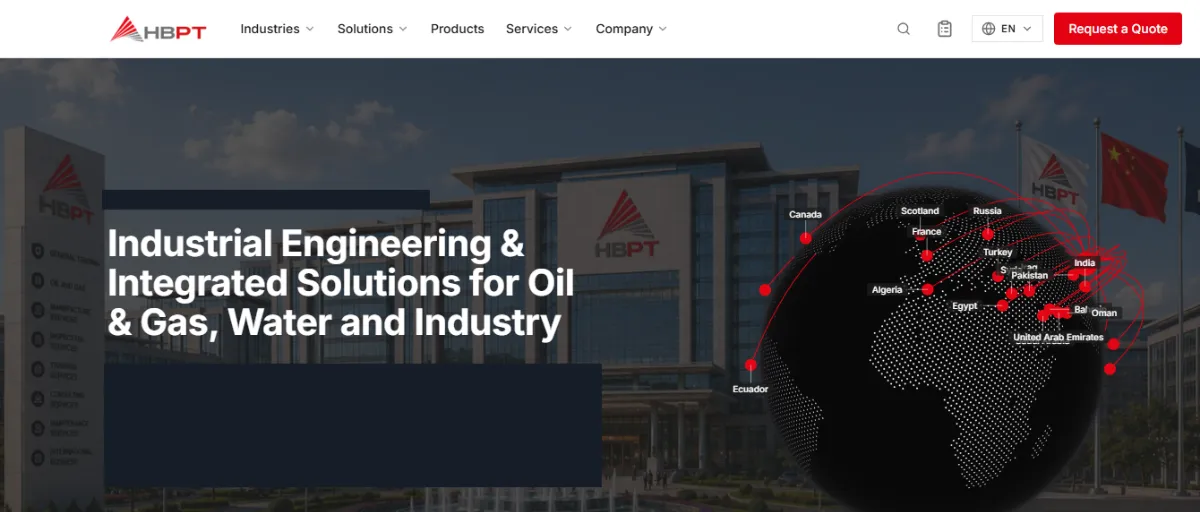
Where HBPT started
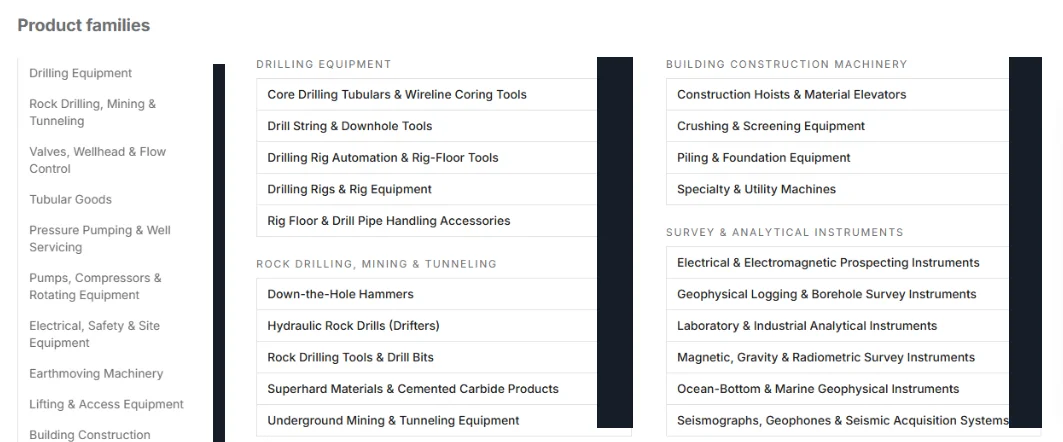
HBPT offers a broad range of equipment, from drilling rigs and pumping equipment to survey and analytical instruments. A paper catalogue couldn’t comfortably hold that range with clear images and detailed technical specifications. Training added a second catalogue with its own process: enrolment, attendance, assessment and certificates.
Behind the website, an enquiry can lead to a quotation, and an accepted quotation to an order, an invoice and, where the work needs one, a delivery project.
What we had to work within
Some information had to stay private. HBPT decided what must never appear in public, so its rules became part of how records are published.
Not every product had a photograph that could be published.
A large catalogue had to stay reliable. As the catalogue grew, every published product still needed to show.
Several languages, uneven translation. The site serves visitors in several languages, but not every product has a translation in each of them.
What we delivered
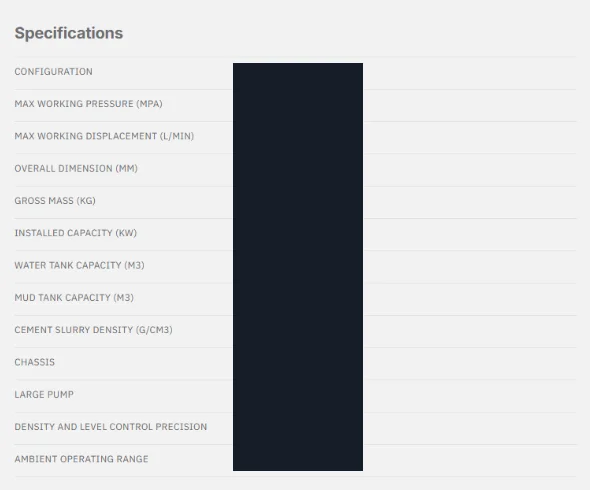
- A public website that presents HBPT’s industries, solutions, services and equipment, with structured product specifications and a way to request a quotation.
In the 21 September 2026 snapshot, the public catalogue listed more than 3,000 products in close to 100 families.
- A staff workspace of more than 50 screens with role-based access, where staff manage products, enquiries, quotations, orders, invoices, delivery projects and training.
- Three portals with their own sign-in, for customers, suppliers and trainees.
- Public services for checking a certificate and evaluating a course.
- A training catalogue of nearly 5,000 course entries across more than 40 disciplines.
- Website editing from the platform: staff can update supported sections of the website themselves.
- The site in nine languages. Where a product has no translation, its English text is shown.
- A handover package of ten documents, including a user guide of more than 200 pages, covering operation, maintenance, cutover, SEO and future upgrades.
Want something similar for your business?
Decisions that shaped the work
One set of records behind everything
Staff manage product, commercial and training records in one place, and decide what is ready to publish. The public website reads only the records that are eligible for it.
Confidentiality built into publishing
Before a product can enter the public catalogue, it is checked against the confidentiality rules, and a publication hold keeps a record private until it’s cleared.
Honest equipment images
Where a product had no publishable photograph, we showed a drawing of its equipment class or a clear “Technical drawing to follow” card. The drawings represent a class of equipment. They don’t claim to show the exact unit. In the 21 September 2026 snapshot, more than 2,700 products had photographs, about 340 showed a class drawing and a few dozen showed the placeholder.
Less data, same products
As the catalogue grew, the data behind its pages became too large to stay reliable. We changed what the catalogue sends to its pages, so they receive only the product details they show. No products or product records were removed. Measured on 1 August 2026 on the same set of about 540 catalogue entries, the data fell from about 11 MB to about 0.74 MB: 93% less.
A dashboard that points to the next action
The staff dashboard brings forward the work waiting for a person: won work with nothing started, qualifications about to expire, enquiries without an owner and quotations waiting to be sent.
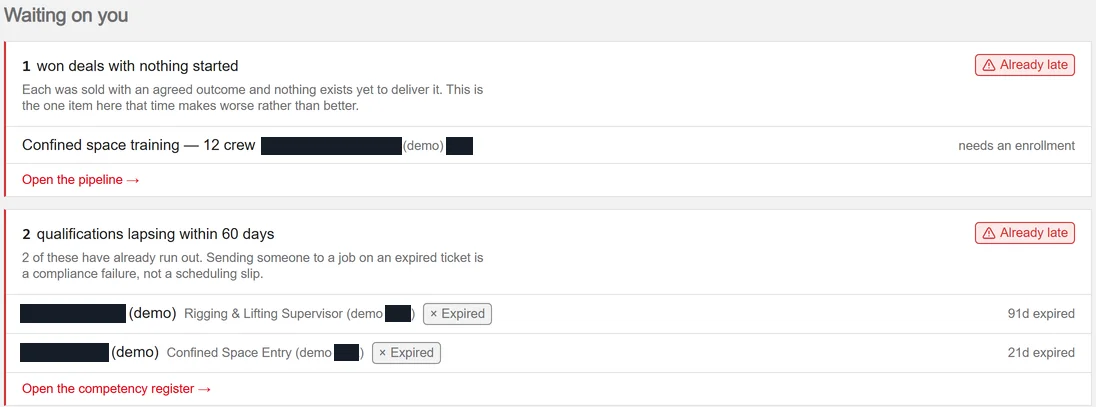
The staff dashboard’s queues, shown with demonstration records. Names and codes are covered, and the counts and durations are illustrative, not HBPT’s results. 
The quotation workspace separates draft, sent, accepted and rejected quotations, and a quotation can be created from an accepted request for quotation. The counts are illustrative. Certificates that follow the rules
Before a certificate is issued, the platform checks that the trainee has met the required attendance and has a recorded pass. Reading a lesson is tracked separately and doesn’t count towards a certificate on its own. Anyone with a certificate number can check it on a public verification page.
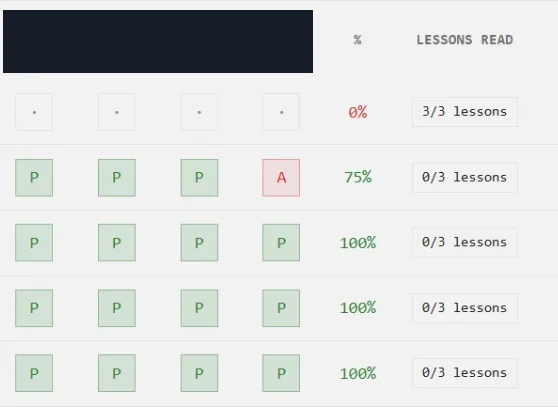
Attendance and lessons read in the training-delivery view. Trainee names and enrolment references are left out, and the session dates are covered. 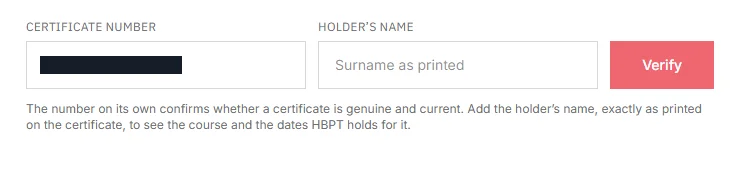
The public certificate check. The example number in the form is covered, and no real certificate is shown.
Want to talk about your own catalogue or workflow?
Evidence and its limits
We want you to be able to rely on this page, so here is what the evidence shows and where it stops.
- Delivered work and measurements: “What we delivered” and “Decisions that shaped the work” describe finished work, not plans. A figure with a date was measured on that date; it isn’t a live value.
- Figures: the published catalogue and training counts come from a rounded 21 September 2026 snapshot. In the 21 September 2026 snapshot, the public catalogue listed more than 3,000 products in close to 100 families. The catalogue expansion plan of 14,000+ products and software capacity beyond 60,000 were confirmed by the owner on 8 October 2026. They are not current published counts, a load-test result or a performance guarantee. Scope figures come from project documentation; other measurements carry their own dates.
- The 93% reduction is a measured change in the amount of catalogue data, on one date. It isn’t a measure of page speed, sales or conversion.
- Home page speed: on 21 September 2026, three readings of how quickly the home page began to load were between 0.37 and 0.45 seconds. They’re observations, not a guaranteed service level.
- Screenshots: the project records date them to 22 September 2026. We’ve cropped them or covered parts for privacy. They show the interface, not end-to-end tests, and demonstration values are illustrative.
- Confidentiality checks and certificate rules are documented processes, not an independent audit or certification.
- Business results such as revenue, conversion or return on investment weren’t measured, and this case study doesn’t claim them.
- HBPT Systems, the platform and website we built, is HBPT’s platform, not a RootMax product.
Credits: Developed by RootMax Team.
Related services
Facing something similar in your business?
Tell us what needs to work better, whether it’s your catalogue, your enquiries or the work that follows them. Choose a time that suits you, and we’ll use the call to understand your business and find the right next step.
Free · 45 minutes · Google Meet · English or Arabic
Describe your projectPlease don’t send passwords, access details or confidential customer data by email.